
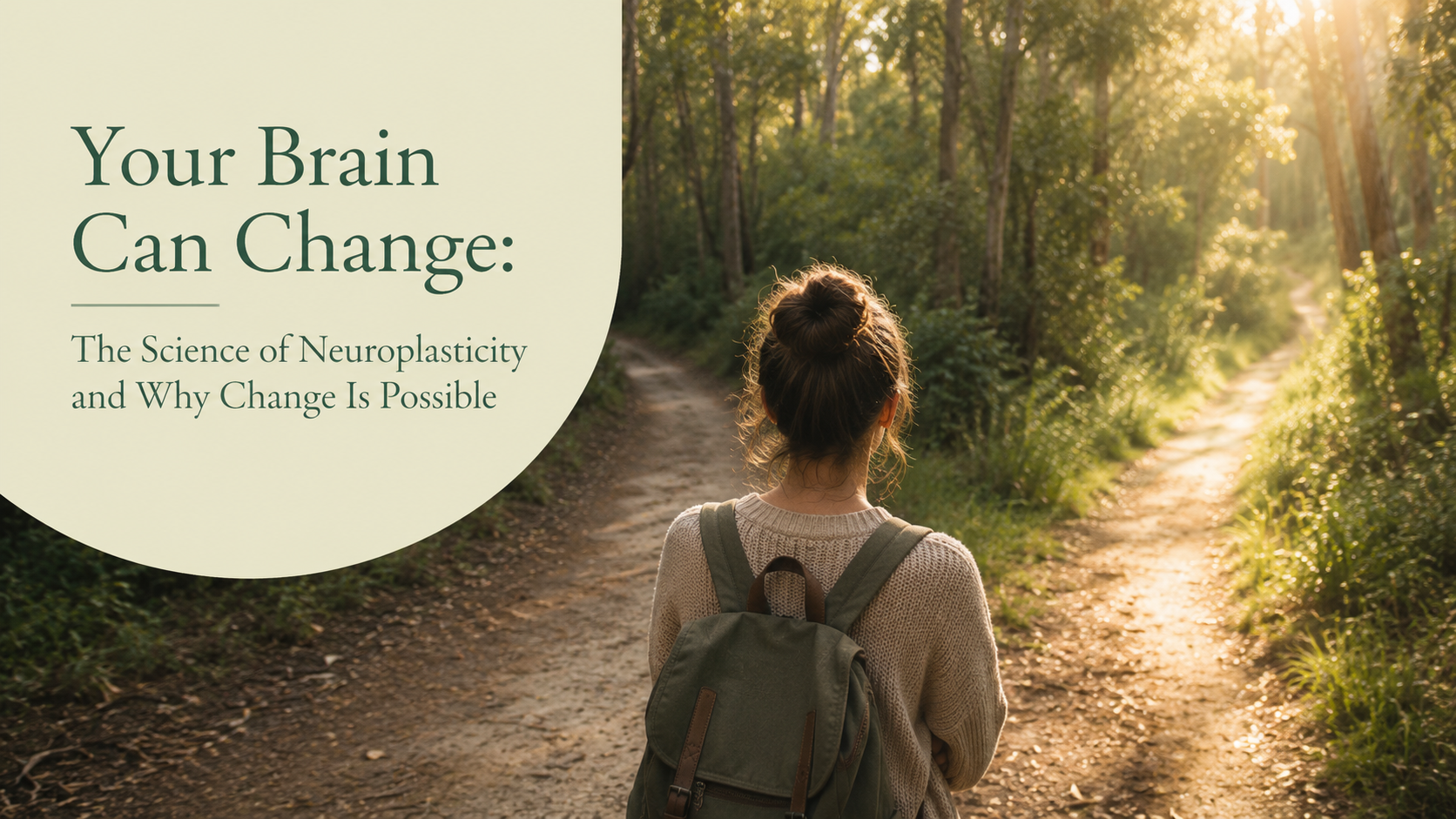
Have you ever found yourself reacting the same way, even when you genuinely want to change? Perhaps you become overwhelmed by stress, avoid difficult conversations, or fall back into habits that no longer serve you.
The encouraging news is that your brain is far more adaptable than many people realise.
This remarkable ability is known as neuroplasticity – your brain’s ability to form, strengthen, and reorganise the neural pathways that allow brain cells to communicate with one another. Thanks to neuroplasticity, our brains continue to learn, adapt, and develop throughout life, making meaningful psychological change possible.
Whether you’re learning healthier coping strategies, managing anxiety, improving relationships, or recovering from difficult experiences, your brain has the capacity to build new patterns over time.
Neuroplasticity refers to the brain’s ability to change by creating and strengthening neural pathways. These pathways are the communication routes your brain uses every time you think, feel, or behave.
Every experience you have shapes your brain. The more often a pathway is used, the stronger and more efficient it becomes. This is why many behaviours eventually feel automatic.
Fortunately, the same process allows us to develop healthier patterns.
Imagine walking through a dense forest.
The first time you take a new route, it’s difficult. You push through branches, step over fallen logs, and the path is barely visible. Every step requires effort.
However, the more often you walk that same route, the clearer and easier it becomes. Eventually, it becomes a well-worn path that you can follow almost without thinking.
Our brains work in much the same way.
Repeated thoughts, emotions, and behaviours strengthen existing neural pathways. Over time, these pathways become your brain’s preferred route because they are familiar and efficient.
The encouraging news is that new pathways can also be created.
Older pathways don’t simply disappear, but they become less dominant as new pathways are strengthened through repeated practice. Like repeatedly choosing the new track through the forest, every small step helps your brain build a healthier route.
Many people struggle with emotional regulation, communication, stress management, or distress tolerance. These challenges are often mistaken for personality traits.
In reality, they are skills.
Some people never had opportunities to learn healthy coping strategies while growing up. Others developed coping mechanisms that were incredibly helpful during difficult periods of life but no longer serve them today. Sometimes life’s demands simply increase, making old strategies less effective. This doesn’t mean there is something inherently wrong with you. Rather, it reflects a skills gap rather than a personal flaw. The good news is that skills can be learned. Whether it’s developing healthier coping strategies, improving communication, building emotional regulation, increasing distress tolerance, or changing long-standing patterns of thinking, your brain remains capable of adapting throughout your life.
This is one of the reasons psychological therapy can be so effective. Therapy isn’t about talking through problems. It provides opportunities to understand your experiences, learn evidence-based skills, practice them repeatedly, and gradually strengthen healthier ways of responding. Over time, these repeated experiences support your brain’s natural capacity for neuroplasticity.
Meaningful change rarely happens overnight. Like creating a new path through a forest, lasting change requires patience, repetition, and persistence.
Every time you choose a healthier response, communicate differently, practise emotional regulation, or respond according to your values, you’re strengthening new neural pathways.
Your past may explain how certain patterns developed, but it doesn’t have to determine where your future leads. With time, support, and consistent practice, healthier responses can become your brain’s new default.
Yes. Research consistently shows that the brain remains capable of adapting throughout adulthood. While learning may occur differently across the lifespan, neuroplasticity continues throughout life.
Psychological therapy helps people learn and repeatedly practise new ways of thinking, feeling, and behaving. Through repetition, these experiences support neuroplasticity and strengthen healthier neural pathways.
There isn’t a fixed timeframe. The brain changes gradually through consistent practice. The more often a new skill or behaviour is repeated, the stronger the associated neural pathway becomes.
Not necessarily. Existing pathways are often well established, which is why change can initially feel uncomfortable. However, with persistence and repeated practice, new pathways become stronger and more automatic over time.
If you’re feeling stuck in patterns that no longer serve you, you don’t have to navigate change alone.
At PsychologyCare, our psychologists use evidence-based therapies to help people develop healthier coping strategies, improve emotional wellbeing, strengthen relationships, and build lasting psychological skills.
Every small step you take is an opportunity for your brain to learn something new.
Hannah Humphris
General Psychologist | Clinical Psychology Registrar








 HealthShare