
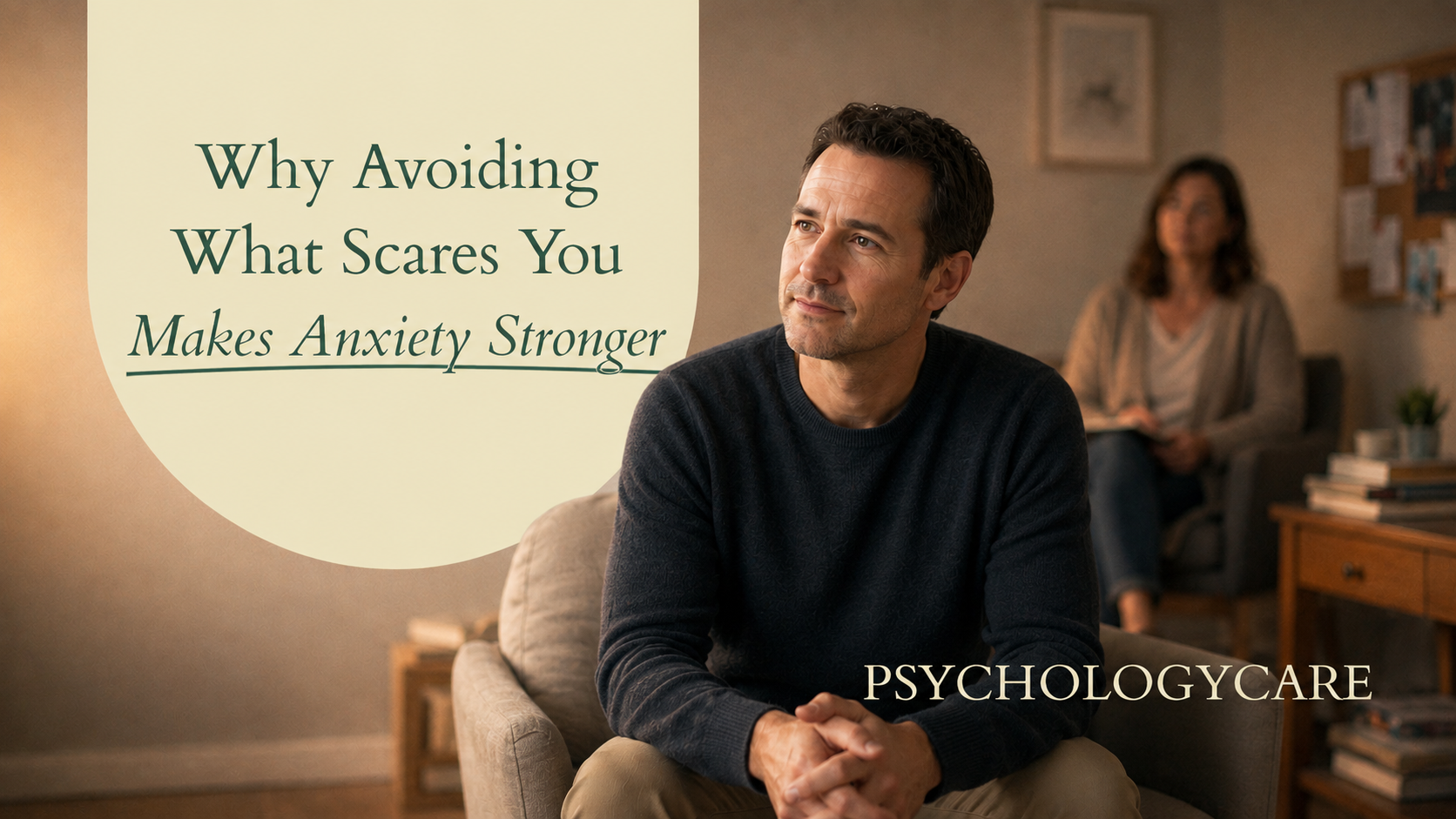
You know the moves. You take the long way home to skip the intersection where you had the crash. You type a message, hover over send, then delete it. You discover you’re busy the weekend of the party. And each time you dodge, relief washes through you within seconds.
As a psychologist, I hear about that relief in almost every conversation about anxiety. It feels like the anxiety backing off. It works more like a payment. Every avoided situation buys a moment of calm at the price of a louder alarm next time. This is the avoidance cycle: it brings immediate relief but can make anxiety worse over time.
Anxiety often involves your brain making a prediction: something bad will happen if you go there, say that or drive that road. When you avoid, the predicted disaster never arrives, the alarm switches off and relief floods in. Your brain files the whole sequence away as a win. We escaped. Avoidance saved us.
Two things follow, and both make anxiety stronger.
First, the relief acts as a reward. Behaviour that gets rewarded gets repeated, so avoiding becomes more automatic each time. Psychologists call this negative reinforcement, and it is the engine room of many anxiety problems I treat.
Second, and this is the part most people miss, the scary prediction never gets tested. Your brain forecast catastrophe at the party. You didn’t go. So, as far as your brain can tell, the forecast might have been spot on. The fear survives untouched, and it will be waiting, a little louder, at the next invitation.
Avoidance doesn’t only mean staying home, either. Going to the party but gripping your phone all night, rehearsing your exit, keeping a mate on standby or only driving if your partner is in the car: psychologists call these safety behaviours. Although they can sometimes help someone approach a feared situation initially, relying on them may prevent the brain from learning that the situation is manageable without them. Your brain credits the props for your survival instead of updating the forecast.
For decades, we thought facing your fears worked through repetition: do the scary thing over and over until you get used to it, like a song you’ve heard too many times. Contemporary exposure research, including influential work led by Professor Michelle Craske and colleagues, suggests that facing fears is not simply about repetition until the anxiety disappears. An important part of the process is helping your brain update its predictions through new learning.
The principle is called expectancy violation, and it is simpler than it sounds. New learning depends on the gap between what your brain predicted and what happened. Predict mild discomfort and get mild discomfort? Tiny gap, little learned. Predict, “I’ll panic, everyone will notice, I’ll have to bolt,” then have an ordinary, slightly awkward evening? Big gap. That gap is where the rewiring happens.
One more piece worth knowing: facing a fear doesn’t delete the old fear memory. It builds a new memory—”I did that and I coped”—which competes with the old one and, with practice, wins the argument most days. The old memory can still pipe up from time to time. That is normal, and it is why a wobbly week doesn’t mean you’re back at square one.
Knowing the mechanism changes how you approach the scary thing. Four principles matter most.
Sometimes the feared thing happens anyway. The call goes badly. The silence at dinner is awkward. When it does, compare the real cost with the forecast catastrophe. Awkward is not the same as unbearable, and a brain that learns “sometimes it goes rough and I cope anyway” ends up sturdier than one taught “it always goes fine.”
Reading about this is one thing. Doing it with a fear that has been running your decisions for years is another. Attempting exposure in overwhelming leaps, or without understanding the behaviours maintaining the fear, may make the process more distressing or less helpful.
Exposure therapy done well is collaborative and paced. A psychologist helps you map the predictions, build a graded series of tests you agree to in advance and debrief each one so the learning lands. Nobody throws you in the deep end.
This approach sits within cognitive behavioural therapy (CBT), one of the best-supported treatments for anxiety, panic, phobias, social anxiety and OCD. The same principles guide our work with kids who are frightened of school and with adults who haven’t driven past the crash site since the accident.
If anxiety has been shrinking your world, talk to your GP about whether a Mental Health Treatment Plan is appropriate. Eligible patients may receive Medicare rebates for psychology sessions. You can also contact PsychologyCare directly to discuss appointments with one of our psychologists on the Gold Coast.
Mathew Van Velsen
Psychologist | Clinical Psychology Registrar




 HealthShare